
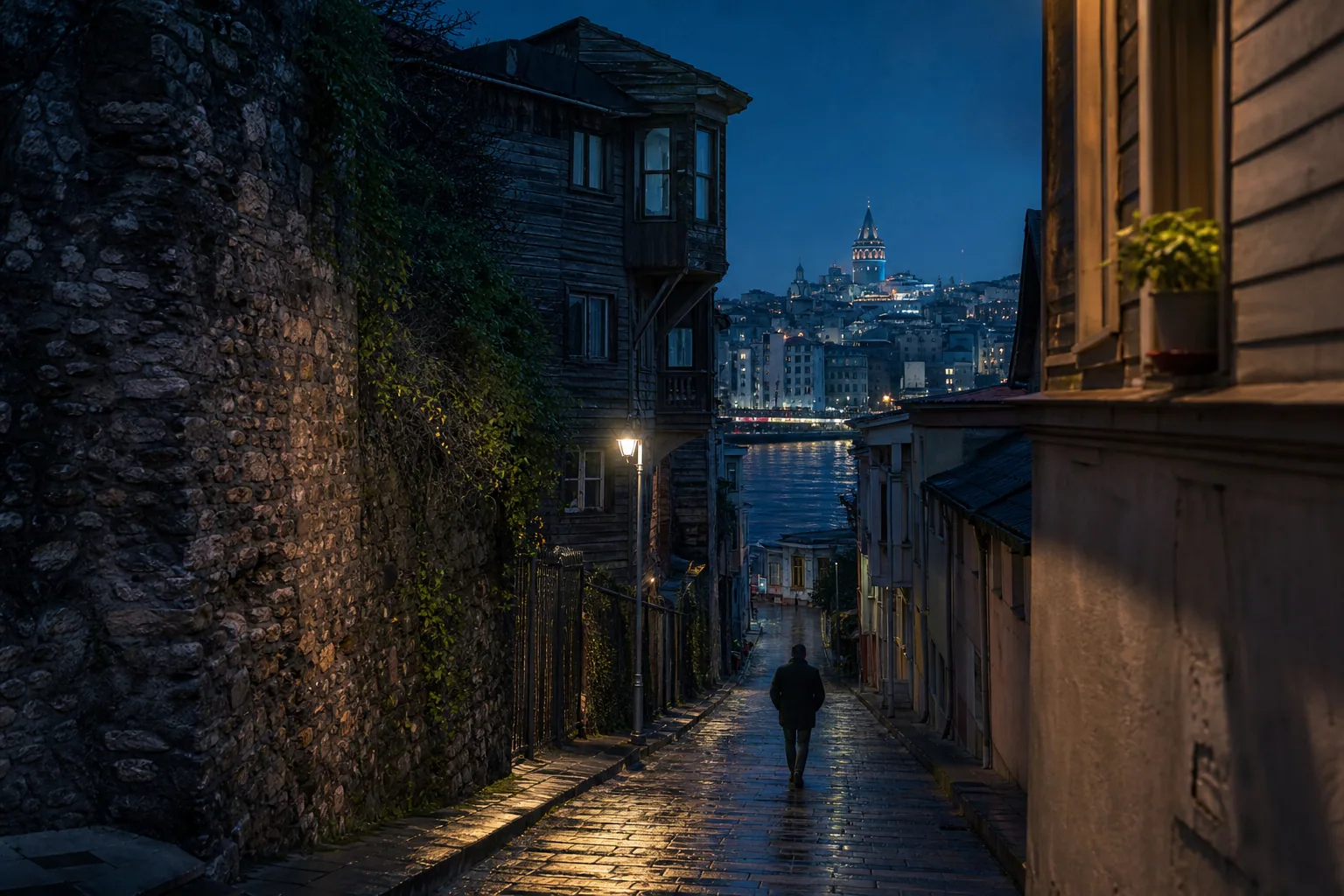
Streets carry rhythm, space and memory like sentences. How knowing a city through steps rather than windows makes details and stories visible. I am writing this record not simply to reach a conclusion, but to make visible the space the question opens in me. Instead of closing an idea too quickly, I follow how it appears in daily life, work and relationships. I want to leave an open table for thought rather than a final judgement. I therefore try to keep a distance between personal experience and a universal claim. I find value in an idea not when it offers the same answer to everyone, but when it opens new and honest questions inside different lives.
WHEN SPEED FALLS
Passing through a city by vehicle shows destinations; walking reveals the life between them. An old door, a corner shop, pavement rhythm and window light appear only when speed falls. Walking is not consuming a city, but reading its sentences in sequence.
LAYERS. Cities like Istanbul carry many times at once. An old wall sits beneath a new building; a silent courtyard waits beside a crowded avenue. The walker feels transitions between these layers through the body. The city is not one identity but a long text written over itself, with some words erased.
THE STORY OF THE ROAD. Walking lets us read people as well as surroundings: a shopkeeper preparing for morning, someone running for a ferry, a flower that has occupied the same window for years. We may never know their complete stories, but imagination creates an invisible connection and leaves new details for writing.
Walking is the simplest way to refuse the speed a city imposes on us. From inside a vehicle, buildings, people and signs pass as connected images; on foot, the distance between them gains meaning. We notice where a neighbourhood becomes quiet, where the pavement narrows and how shopkeepers occupy the street. Borders absent from the map appear. Our pace increases on certain streets and slows at particular corners. The body reads the city before the mind, recording safety, curiosity and unease through small movements.
For a writer, the value of walking is not limited to collecting stories. It returns rhythm to the body. Through my steps I begin to understand where a long sentence should breathe and how long a scene must last to feel real. People I encounter do not become characters directly, but a glance, a manner of waiting or a way of speaking may give life to someone fictional. The city does not offer finished stories; it leaves signs. The writer's task is not to steal them but to rebuild the question they open inside another world. Some texts begin not at the desk, but on the road back to it.
THE VALUE OF GETTING LOST
A map leads to the shortest route; curiosity sometimes chooses the wrong street. Leaving the plan allows the city to reveal itself. Getting lost is not always losing direction. Sometimes it is escaping a familiar gaze and seeing something new in a place we thought we knew.
Walking through Istanbul, I feel that time does not move along a single line. A century-old stone may stand beside a new facade, and a forgotten courtyard may wait a few steps from heavy traffic. The city does not keep its past inside a museum; it mixes it into daily life. That mixture is sometimes beautiful and sometimes harsh. Change is visible not only in new shops but in sounds that can no longer be heard. A vanished craft, a closed cinema or a sign replaced by another language resembles a sentence erased from the city's memory. The person walking can read these losses.
At the end of a walk, I do not always arrive at certain knowledge about the city. Sometimes I return with contradictions I had never noticed. Time flows differently for someone hurrying along a pavement and someone who has sat in the same chair for hours. A facade admired by a visitor may signal rising rent to the person living behind it. A city has no single narrator, and reading it honestly means seeing the lives behind the images we love. Walking reminds me of the responsibility of looking: not turning people into decoration, poverty into atmosphere or the past into a romantic background. To read a city is not merely to collect its beauty, but to ask who can walk freely, who remains unseen and who pays the price of change.
READER SIGNAL
Leave a sentence on this file.
Your signal passes a digital check before entering the archive.