
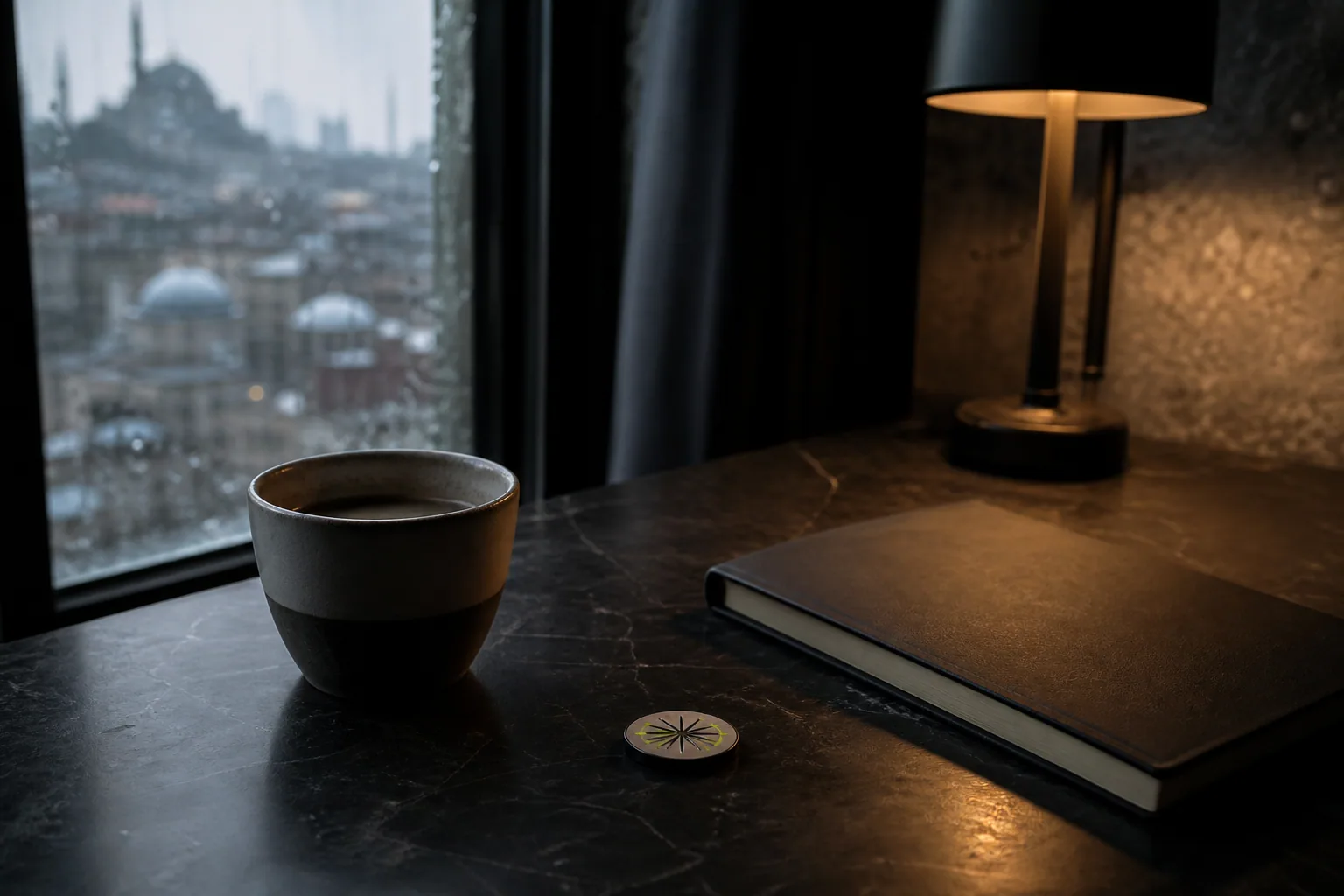
Some major decisions form in quiet, ordinary moments. Separating decisions from speed, the space waiting opens for thought and the power of daily rituals. I am writing this record not simply to reach a conclusion, but to make visible the space the question opens in me. Instead of closing an idea too quickly, I follow how it appears in daily life, work and relationships. I want to leave an open table for thought rather than a final judgement. I therefore try to keep a distance between personal experience and a universal claim. I find value in an idea not when it offers the same answer to everyone, but when it opens new and honest questions inside different lives.
NOT FORCING THE ANSWER
Some decisions become clear not through more thinking but by leaving thought alone. While coffee cools, the mind appears occupied elsewhere yet quietly rearranges the problem. Giving uncertainty time can reveal connections hidden by urgency.
THE POWER OF RITUAL. Making coffee, approaching a window or writing a note is not the solution, but creates a transition. Ritual slows the body and gathers attention. Major decisions often mature not in dramatic moments but inside repeated, ordinary habits.
DECISION AND LOSS. Every real decision abandons other possibilities. Indecision may come not from missing information but from wanting every door open. Choosing means accepting the loss of other paths. Clarity is not the absence of risk; it is knowing which risk we can carry.
A decision maturing can look similar to a decision being postponed. In both cases we do not act immediately, but in one thought deepens while in the other fear travels around the same circle. To understand the difference, I ask myself whether I am seeing something new while waiting or merely repeating the same anxiety. The brief time in which coffee cools can be enough to notice this distinction. Before leaving the table, the first noise of the mind falls away and the real need at the centre of the decision becomes visible. Waiting is not losing time; it is separating the voice of a decision from the urgency surrounding it.
Not every quiet moment produces the right answer; calm must not be confused with certainty. Sometimes the option that comforts us simply allows us to avoid conflict in the short term. I therefore consider the responsibility that follows a decision. Does the road that makes me freer invisibly increase another person's burden? Is today's convenience preparing a heavier problem for tomorrow? A decision made while coffee cools is not a romantic accident, but a way of inviting consequences hidden by haste to the table. A good decision does not always feel comfortable, but it can carry a clear account of why it was made.
THE COOLING CUP
Cooling coffee is a small measure of passing time. Sometimes we warm it, sometimes drink it cold, and sometimes the decision has already been made when we leave the table. We cannot manage every stage of thought. We can give it a quiet space and remain attentive enough to recognise the answer.
We often connect major decisions to one courageous moment. Yet choices such as changing work, leaving a project or beginning another life start much earlier through small internal sentences. One morning we realise we are tired of the same question; another day we discover we no longer believe the old answer. The final step only makes a long accumulation of knowledge visible. Daily rituals create room to hear this accumulation. The same cup, the same table or a few minutes beside a window give the mind a chance not to decide, but to recognise what it already knows.
The ritual does not end once a decision is made. What makes a choice real is not the certainty reached in the mind, but the ability to perform the small action it requires the next day. Making the call, closing the file, speaking honestly to someone or placing the first step on the calendar: large declarations become part of the old indecision when they are never translated into daily life. I therefore try to end the note beside my coffee with a concrete act. When, with whom and through which first step? If I cannot answer, perhaps I have created a good intention rather than a decision. Calm may show us the direction; walking the road requires repetition, discipline and sometimes choosing the same thing again every morning. Life-changing choices are usually not single acts of heroism, but the sum of small loyalties.
READER SIGNAL
Leave a sentence on this file.
Your signal passes a digital check before entering the archive.