
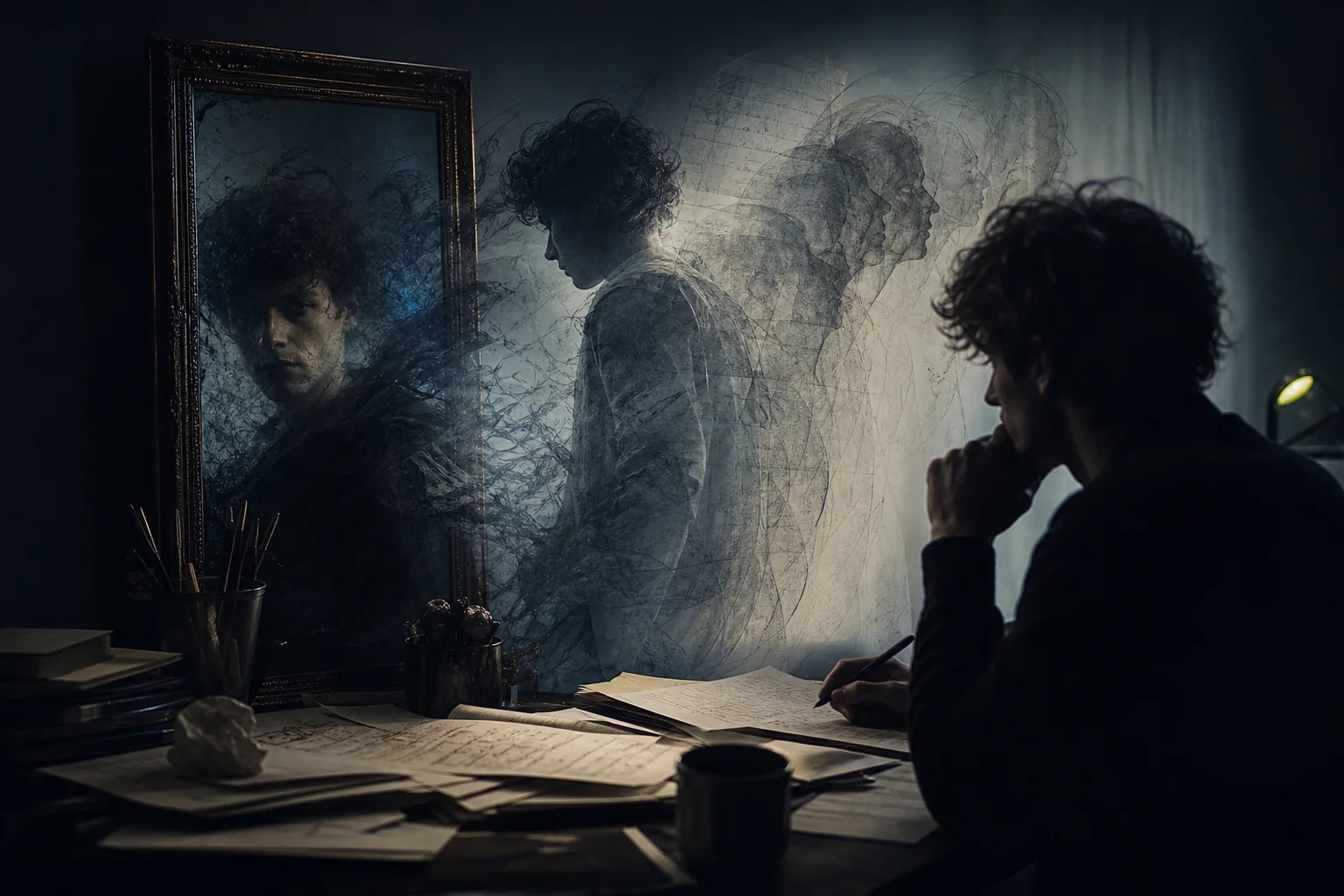
More than a name, a past and a description. The moment a fictional character leaves the writer's plan and begins living by an inner logic. I am writing this record not simply to reach a conclusion, but to make visible the space the question opens in me. Instead of closing an idea too quickly, I follow how it appears in daily life, work and relationships. I want to leave an open table for thought rather than a final judgement. I therefore try to keep a distance between personal experience and a universal claim. I find value in an idea not when it offers the same answer to everyone, but when it opens new and honest questions inside different lives.
FROM FILE TO PERSON
Age, profession, appearance and history create a file, not yet a human being. A character becomes real through tension rather than perfect consistency: when the brave person becomes afraid, which truth the honest one conceals, and how the apparently strong person collapses in private.
THE STORY THEY TELL THEMSELVES. Everyone tells themselves a story to explain what they do. A character is shaped not only by the past the writer provides, but by how they interpret it. The same loss may lead one person to justice and another to revenge. Both may believe they are right. Reality begins in the distance between what a character says and what they do.
RESISTING THE WRITER. The strongest sign of life is resistance to the writer's convenient solution. Force an unsuitable decision merely to move the plot and the text reveals the lie. A living character is no longer a vehicle for events; fear and desire alter the direction of the scene. That resistance makes writing harder and fiction more alive.
A character is not made real by the amount of information collected about them. Height, eye colour, childhood and favourite food give us a detailed file, not a living person. Reality begins when a character is trapped between two truths. If every choice costs something, readers recognise that inner conflict from their own lives. People are defined less by their traits than by the price they are willing to pay. When building a character, I therefore ask not only what they want, but what they cannot sacrifice to obtain it. The story begins to move precisely when those two forces touch.
The strongest characters never explain themselves completely. In life, there are spaces between what a person says and withholds, between what they do and what they wanted to do. Readers use their own experience inside those spaces and complete the character alongside the writer. Naming every emotion and explaining every motive can therefore make a character smaller rather than deeper. A hand trembling beneath a table may say more than pages of interior monologue. Reality is built not through information but through a carefully chosen contradiction that continues inside the reader. If a character remains in the mind after the book closes, they have stepped off the page.
THE FACE COMPLETED BY THE READER
If the writer closes every detail, the reader has nowhere to enter. A gesture, unfinished sentence or recurring habit may carry more power than explanation. Readers bring experience into those spaces and complete the character in their own minds. A real character is not made by the writer alone, but kept alive by text and reader together.
The writer's control over a character should not be unlimited. Readers immediately feel when we force a character to act against their nature merely to reach a planned scene. A fictional person's freedom is the inner consistency born from their past and their wounds. Sometimes a chapter prepared for months must change because the character would never walk through that door. This resistance is not an obstacle to writing; it is evidence that the text has begun to live. When a character can say no to the writer, they cease to be a vehicle for plot and acquire their own weight.
When a character becomes real, the reader does not have to love them, but should feel the inevitability of their behaviour. Faced with a terrible choice, readers may say they would never do the same and still understand why that person did it. Literature's empathetic power does not confuse right and wrong; it simply forces us to look before judging. This distance matters especially with dark characters. If we make them entirely alien, we become comfortable because evil appears to belong elsewhere. If we excuse them, we erase the victim's reality. The writer walks between those dangers: showing the character's humanity without removing responsibility for the act. A living character leaves a difficult question rather than an easy verdict. We remember them not because of heroism, but because they come uncomfortably close to our own possibilities.
READER SIGNAL
Leave a sentence on this file.
Your signal passes a digital check before entering the archive.