A 27-year personal history of technology that began with one computer. My journey from a computer brought home after the 1999 earthquake to today's generative AI systems. I am writing this record not simply to reach a conclusion, but to make visible the space the question opens in me. Instead of closing an idea too quickly, I follow how it appears in daily life, work and relationships. I want to leave an open table for thought rather than a final judgement. I therefore try to keep a distance between personal experience and a universal claim. I find value in an idea not when it offers the same answer to everyone, but when it opens new and honest questions inside different lives.
A COMPUTER FROM THE RUINS
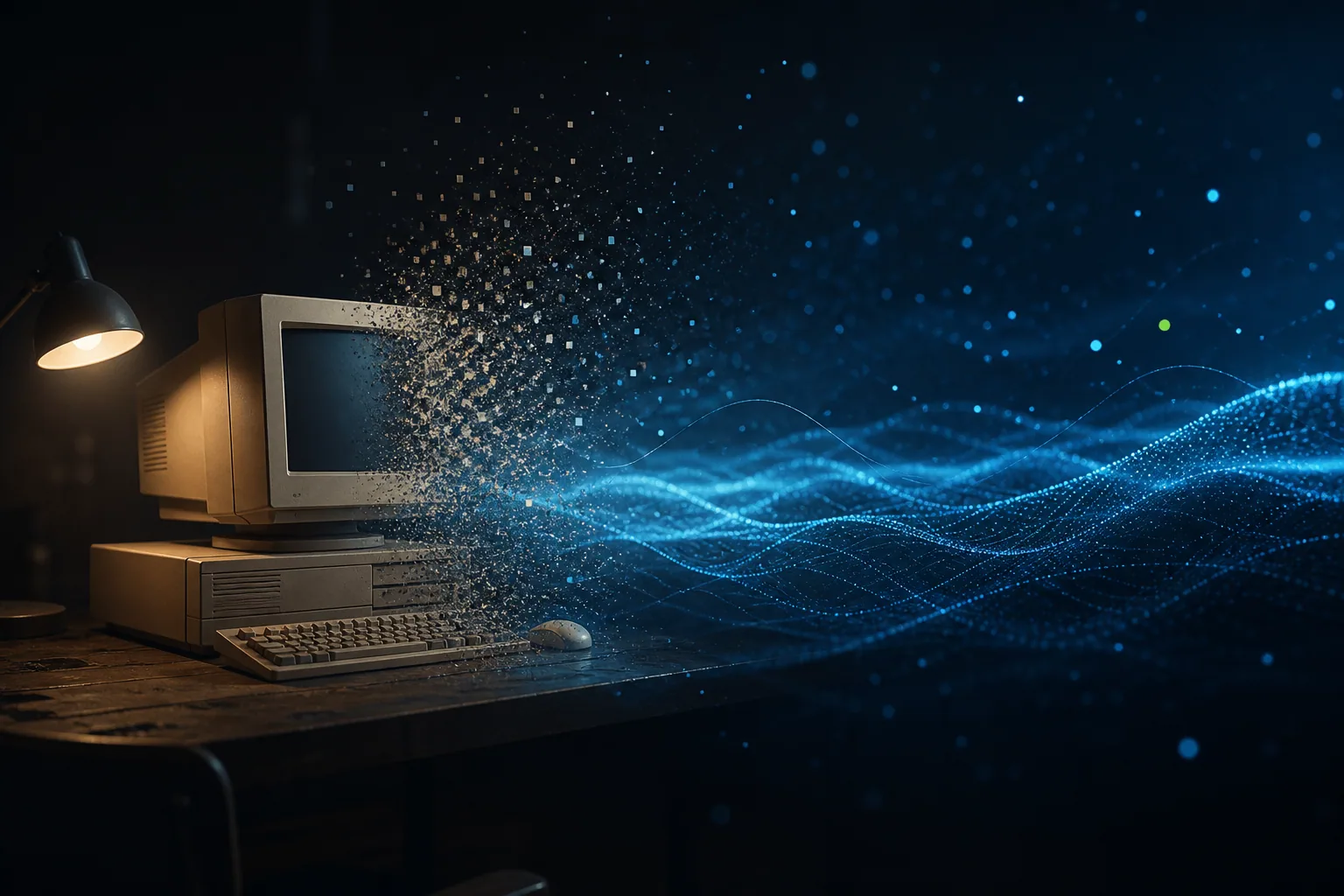
My first computer was not a planned gift. It came home from our shop after the 1999 Gölcük earthquake, running Windows 95. It was more than a case, screen and keyboard. At a time when I had seen how suddenly life could change, it opened a world whose rules could be learned and whose broken parts could be rebuilt.
THE LANGUAGE OF CURIOSITY. Information was not as immediate then. Solving a problem required patience, experimentation and sometimes the courage to break a system and rebuild it. The computer taught me more than software; it taught me to understand how a system thinks. Error messages became clues. That approach later shaped the way I solved problems as a manager and technology leader.
FROM USER TO CREATOR. The computer gradually stopped being a world to consume and became a place to create. Websites, graphics, digital cards and brands followed. When I founded ByTekno in 2020, I carried not only technical knowledge but years of observing how people want to be seen, understood and remembered online. Technology and design could no longer be separated.
Measured by today's standards, that computer in 1999 was extremely limited. For me, however, it was less a machine with limits than a door that taught me how limits could be crossed. When a program failed, there was no ready-made tutorial video. I had to read the error, check the cables, try again and sometimes rebuild the system from the beginning. Those were years when patience and curiosity shared the same desk. The computer taught me not only to use software but to remain unafraid in front of something unknown. The familiar excitement I feel while working with a complex AI system today still has its roots in that room.
When I look at generative AI, I do not see something entirely separate from the computer of my childhood. Both open a new field of possibility in front of the human being. The difference is that today's machine no longer merely follows commands; it accompanies our language, ideas and methods of production. That closeness demands greater care because a tool eventually shapes the rhythm of our thought. My nostalgia for the past is not a request to slow technology down. It is a way of remembering which curiosity must not be lost while moving forward. The future gains meaning in the hands of those who turn the past into method rather than forget it.
ENTERPRISE SCALE
Managing national companies across different regions of Türkiye taught me that technology never exists only on a screen. Every system contains habits, anxieties, power and daily workload. When I became CTO at Barok Yapı in 2025, this was the central lesson: digital transformation is not installing software; it is designing an environment in which people can work more clearly and securely.
A NEW BEGINNING. Generative AI is vastly more powerful than the computer I first sat before, yet the feeling is familiar: looking into a world whose limits we do not yet know. After twenty-seven years, the constant is not technology but curiosity. I do not see AI as the end of the journey, but as a new threshold from which my digital universe begins expanding again.
Over twenty-seven years, devices became smaller, connections faster and information almost invisible. We once felt the physical weight of a process while waiting for a program to install; now millions of operations finish in seconds. This speed is a remarkable opportunity, yet it also risks making memory shallow. When results arrive too easily, we can forget what the road taught us. I therefore try to preserve the old habit of taking things apart while using new tools. Understanding not only what a system does but why it behaves that way still marks the difference between remaining a user and becoming a maker.
I do not see this journey as a straight story of progress. Each new technology did not solve every problem of the one before it; it made some invisible and introduced new ones. The internet liberated access to information while increasing noise, social networks connected people while fragmenting attention, and artificial intelligence simplified production while making questions of originality and responsibility heavier. Even so, I am not pessimistic. The same twenty-seven years have shown me that technology is not destiny but design. How we use it, which limits we establish and whose benefit we prioritise are decisions that can be changed. The computer of 1999 opened a door for me. Today my task is not only to walk through new doors, but to make their destinations understandable for those who follow. Experience matters not as resistance to innovation, but as the ability to give it direction.
READER SIGNAL
Leave a sentence on this file.
Your signal passes a digital check before entering the archive.