
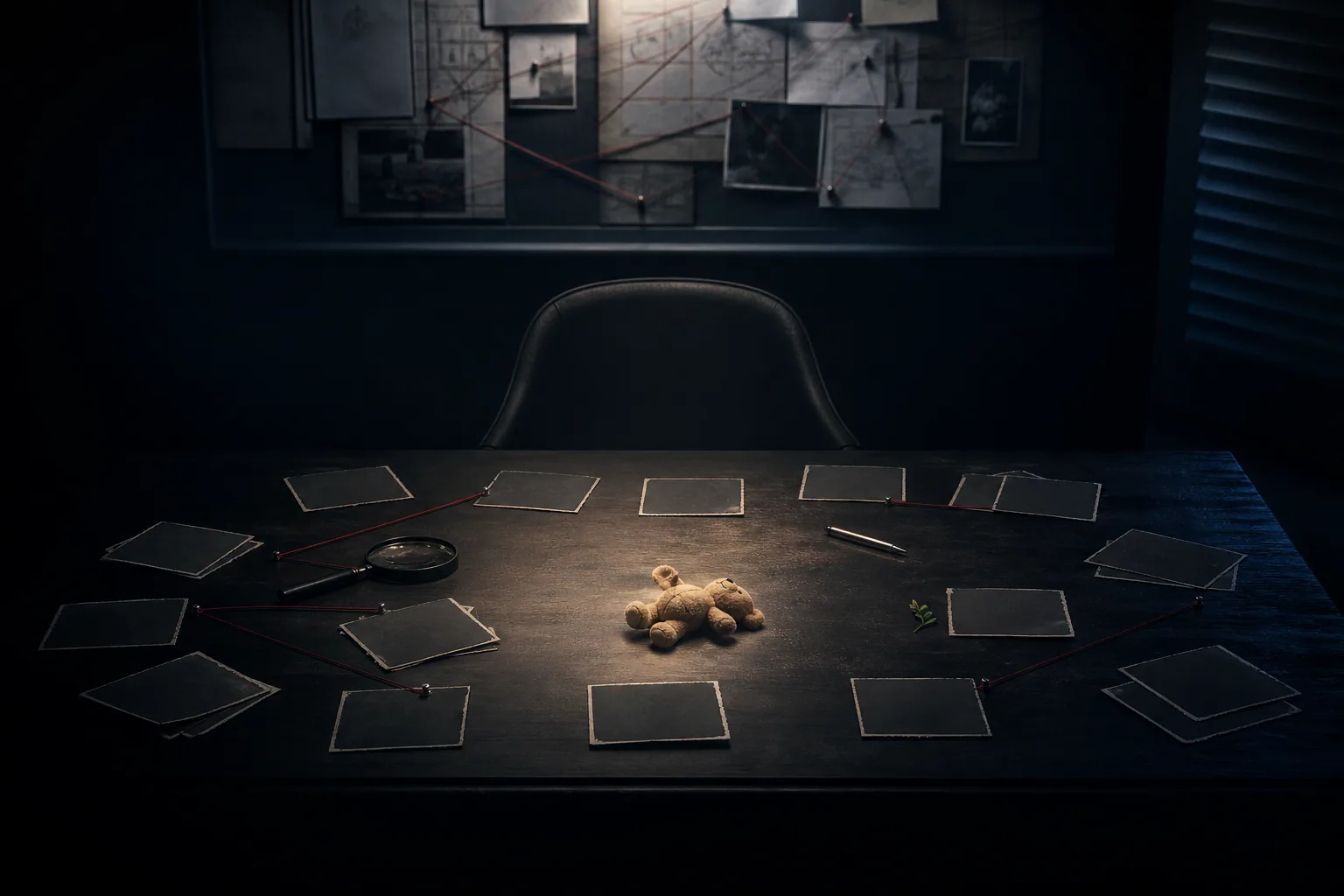
The difference between solving a crime and understanding darkness. Why strong crime fiction investigates the fracture that made the crime possible, not only the identity of the culprit. I am writing this record not simply to reach a conclusion, but to make visible the space the question opens in me. Instead of closing an idea too quickly, I follow how it appears in daily life, work and relationships. I want to leave an open table for thought rather than a final judgement. I therefore try to keep a distance between personal experience and a universal claim. I find value in an idea not when it offers the same answer to everyone, but when it opens new and honest questions inside different lives.
THE LIMIT OF WHO
Crime fiction naturally asks, 'Who did it?' The question moves the story, but cannot carry it alone. If all curiosity ends when the culprit is revealed, we are left with a well-built puzzle. For the novel to last, it must ask a second question: what brought a human being to this point?
MOTIVE IS NOT EXCUSE. Trying to understand a killer does not justify the crime. Literature is not a court; it looks into the dark regions of behaviour. Loss, shame, love, power and guilt can combine in unexpected ways. Motive does not clean the act. It reveals how the act became possible in a human life.
THE DETECTIVE'S MIRROR. A strong investigator does not only look at darkness outside. Every case exposes their own history, idea of justice and limits. Similarity between detective and killer does not make them equal, but it deepens tension. How close must one come to understand another, and is it possible to return unchanged?
An investigation may end when the offender's name is revealed, but the novel's real question often begins at that moment. The road to murder is not a single decision. It is an accumulation of small silences, unseen wounds, a distorted sense of justice and anger that was never stopped in time. Showing this road does not excuse the crime. It means refusing to place evil inside a supernatural monster and accepting how it can grow under human conditions. When readers understand the killer, they do not agree with them; they discover only that darkness may begin somewhere more familiar than they imagined.
What interests me in Mavi is not how clever the killer is, but how pain becomes a system. When a person begins to see guilt as justice, they can invent a convincing reason for every act. The dangerous element is not only the strength of the impulse but the story that makes it appear righteous. The paths of police officer and offender therefore cross not only over evidence but inside the stories they tell themselves. One wants to complete the past; the other must learn that some gaps cannot be filled by proof. By the final page, readers should see not only who acted, but which idea made murder possible.
WHAT REMAINS AFTER THE ANSWER
The reader may learn the culprit on the final page, but a good novel sends another question home with them. Was justice achieved? Was the victim more than a name in a file? Does solving a crime complete a loss? Crime fiction lasts not through the puzzle's answer, but through the unease that continues growing after it.
In strong crime fiction, the victim must be more than a body that sets the plot in motion. Their interrupted life, the absence left around them and the different shapes they take in other people's memories form the moral centre of the investigation. When murder becomes only a puzzle, death loses its weight. Behind every clue is a person who can no longer answer. The detective's task is not merely to catch the offender but to read that silenced life as truthfully as possible. This turns crime fiction from a mechanical game of intelligence into a human story about loss, justice and memory.
When a crime novel ends, its solution should travel backward and change the entire story. A gesture that appeared ordinary must gain another meaning, a crack inside an innocent sentence must become visible, yet readers should not feel deceived. Motive therefore cannot be a surprise fact delivered at the end; it must be an underground current working quietly throughout the novel. The victims chosen, the order left at a crime scene, the reaction to the police and the method of self-protection should all grow from the same inner wound. Readers may not consciously connect these elements, but they feel their consistency. When the explanation arrives, they should say both 'how did I miss it?' and 'it could not have been otherwise.' Strong crime fiction hides the answer without hiding the truth, placing fragments so they unite only under the final light.
READER SIGNAL
Leave a sentence on this file.
Your signal passes a digital check before entering the archive.